Cricket Darts Rules
Strategic game targeting numbers 15–20 and the Bull. Three variants to choose from.
Overview
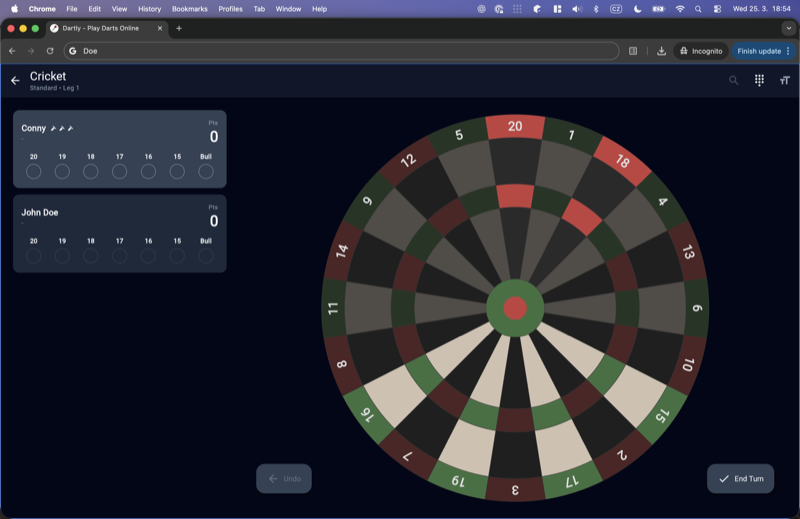
Cricket is one of the most popular darts games, especially in North America. Unlike X01, which is a pure scoring race, Cricket is a strategic game that combines closing specific numbers with scoring points. Players must decide each turn whether to focus on closing new numbers, scoring on numbers they have already closed, or defensively closing numbers their opponents are scoring on.
Cricket uses only seven target numbers — 15, 16, 17, 18, 19, 20, and the Bull — making it more focused than X01 while still rewarding accuracy across different areas of the board.
Game Setup
| Setting | Options |
|---|---|
| Target Numbers | 15, 16, 17, 18, 19, 20, Bull |
| Players | 2 or more (most common: 2) |
| Format | Single leg, best of N legs, or sets format |
| Darts per Turn | 3 |
| Variants | Standard, Cut-Throat, No-Score |
Closing Numbers
The core mechanic of Cricket is closing numbers. To close a number, you must hit it a total of 3 times. Hits accumulate across turns, so you do not need to close a number in a single turn.
- Single hit: Counts as 1 mark toward closing
- Double hit: Counts as 2 marks toward closing
- Triple hit: Counts as 3 marks — closes the number immediately in one dart
For the Bull, a Single Bull (25) counts as 1 mark and a Double Bull (50) counts as 2 marks.
Once a player has 3 marks on a number, that number is closed for them, shown with an “X” on the scoreboard. When all players have closed a number, it becomes dead — no one can score on it for the rest of the leg.
Legs and Sets
Like X01, Cricket supports a professional sets format in addition to single-leg and best-of-N-legs play. A set consists of multiple legs (for example, best of 3 legs per set), and the match is won by the first player to win the required number of sets (for example, best of 5 sets means first to 3). Sets are only available for X01 and Cricket.
In a single-leg match with more than one player, the match doesn't end the instant someone wins — the remaining players keep competing for the other places, ranked by numbers closed, then total marks thrown, then score, until everyone has finished or the leader chooses to end the game early. This applies to all three variants below.
Standard Cricket
Objective
Close all 7 numbers and have a score equal to or higher than all opponents.
Scoring
After you have closed a number (3 marks), any additional hits on that number score points equal to the value of the throw. However, you can only score on a number that your opponents have not yet closed. Once all players have closed a number, it is dead and no longer scores.
Example: You have closed 20 (3 marks). Your opponent has not. You throw Triple 20 — this scores 60 points for you. If your opponent then closes 20 as well, the number becomes dead and neither player can score on it anymore.
Win Condition
To win, a player must satisfy both conditions:
- Close all 7 numbers (15, 16, 17, 18, 19, 20, Bull)
- Have a total score equal to or higher than every opponent
If you close all numbers but have a lower score than an opponent, the game continues. You must either score more points or wait for your opponent to close their numbers while you defend.
Cut-Throat Cricket
Objective
Close all 7 numbers and have a score equal to or lower than all opponents.
Scoring
The key twist: after closing a number, additional hits give points to your opponents who have not yet closed that number. You want to pile points onto your opponents while keeping your own score low.
Example: You have closed 19. Your opponent has not. You throw Triple 19 — this adds 57 points to your opponent's score, not yours. In Cut-Throat, a higher score is bad.
Win Condition
To win, a player must:
- Close all 7 numbers
- Have a total score equal to or lower than every opponent
Cut-Throat is particularly popular with 3 or more players because it adds a layer of politics — you must decide which opponents to target with points.
No-Score Cricket
Objective
Be the first player to close all 7 numbers. No scoring is involved.
How It Works
This is the simplest Cricket variant. There are no points at all — the only goal is to close all 7 numbers as quickly as possible. The first player to close all numbers wins immediately.
No-Score Cricket is a pure accuracy race and is often used for practice or quick games where strategic scoring is not desired.
Starting Player Rotation
To keep multi-leg matches fair, the starting player rotates between legs. The first leg starts with the designated starting player, the second leg with the next player in the order, and so on.
Confirmation Mode
Confirmation Mode is an optional setting you can turn on when creating a game, or toggle mid-game from the top bar. Tapping the dartboard opens a magnified 1.5× overlay showing the segment you hit, its two neighbors, and the Bull — tap the correct segment to confirm the score, or tap outside the overlay to cancel with nothing scored. It's especially useful on small screens for telling apart a Single 20 from a Triple 20 or similar close marks. Misses are always registered immediately and skip the confirmation step.
Strategy Tips
- Close high numbers first: In Standard Cricket, prioritize closing 20, 19, and 18 early. These numbers have the highest scoring potential. If you close 20 before your opponent, every additional 20 you hit scores valuable points.
- Triple is king: A triple closes a number in a single dart, saving you two darts for other targets. Aiming for triples on your target numbers is always the most efficient approach.
- Play defense when behind: If your opponent has closed a number and is scoring on it heavily, you may need to prioritize closing that number defensively to stop the bleeding, even if it means delaying your own offensive strategy.
- Don't ignore the Bull: Many players leave the Bull for last, but it can be difficult to close under pressure. Consider working on it throughout the game rather than saving it for a stressful finish.
- In Cut-Throat, spread the pain: With 3+ players, target the leading player (lowest score) with your scoring throws. Distributing points evenly among opponents can also prevent anyone from running away with the game.
Related Games
Related Articles
Play Cricket Now
Choose Standard, Cut-Throat, or No-Score Cricket. No download needed.
Open Dartly App