Fight Darts Rules
A brawl on the dartboard. Hit your opponents' numbers to take their lives, heal on your own number, and be the last player standing.
Overview
Fight is a brawl on the dartboard. At the start of every leg, each player is dealt their own random number from 1 to 20, and everyone starts with the same number of lives. Hit an opponent's number to take their lives, hit your own number or the Bull to heal. A player who runs out of lives is knocked out, and the last player standing wins the leg.
Every ring counts: a single takes one life, a double two, and a triple three. Each dart is a choice between attacking and healing, which makes Fight a fast, chaotic game for 2 to 8 players.
Game Setup
| Setting | Value |
|---|---|
| Starting Lives | 3, 5, 7, 9, 12, or 15 (default 9) |
| Players | 2 to 8 |
| Format | Single leg or best of N legs |
| Darts per Turn | 3 |
| Round Limit | 25 rounds per leg |
Your Number
At the start of every leg, each player is dealt a random number from 1 to 20. No two players share a number, and the Bull belongs to nobody. Every new leg deals fresh numbers, so nobody keeps the same target for the whole match.
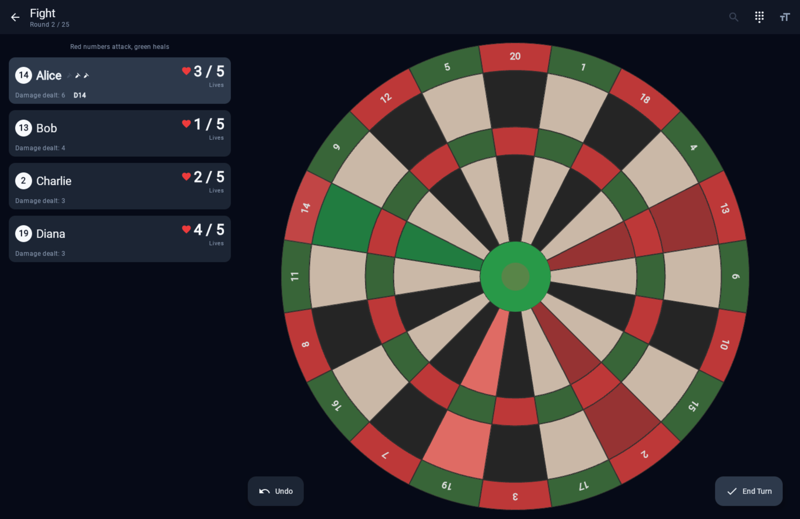
When it is your turn, the dartboard shows your own number and the Bull in green (heal) and the number of every opponent still in the game in red (attack).
Dart Force
Fight has no points, only lives. The ring a dart lands in decides its force — how many lives it takes or heals:
| Segment | Force |
|---|---|
| Single | 1 |
| Double | 2 |
| Triple | 3 |
| Outer Bull | 1 |
| Bullseye | 2 |
| Miss | 0 |
What a Dart Does
What happens depends on whose number the dart lands on:
- An opponent's number: that opponent loses lives equal to the force — a single takes 1, a double 2, and a triple 3. Nobody can lose more lives than they have left.
- Your own number: you heal by the force, so a triple on your own number restores 3 lives at once.
- The Bull: heals the thrower — 1 life for the outer bull, 2 for the bullseye.
- A knocked-out player's number, a number nobody owns, or a miss: no effect. The dart still counts as one of your three.
Lives are capped: you can never have more lives than you started the leg with. Healing at full lives does nothing, so a dart on your own number is wasted while you are at full strength.
Knockouts
A player who drops to 0 lives is knocked out. Knocked-out players are skipped in the turn order, and their number goes dead — hitting it does nothing. Players are ranked in reverse order of elimination: the first player knocked out finishes last.
Win Condition
Last player standing: as soon as only one player has lives left, that player wins the leg on the spot — the rest of the turn is not thrown.
Round limit: a leg lasts at most 25 rounds. Once every player still in the game has taken 25 turns, the player with the most lives wins. A tie goes to whoever dealt more damage in the leg; if that is level too, the player seated later in the player order wins.
When the round limit decides, the other surviving players are ranked the same way, ahead of everyone already knocked out. In a multi-leg match, the final standings are those of the last leg.
Game Flow Example
Three players start a leg with 9 lives each. Alice is dealt 20, Bob 5, and Charlie 1. A few rounds in, Alice has 7 lives, Bob 9, and Charlie 2. Alice throws:
| Dart | Hit | Effect | Alice (20) | Bob (5) | Charlie (1) |
|---|---|---|---|---|---|
| 1 | T5 | Bob loses 3 lives | 7 | 6 | 2 |
| 2 | D1 | Charlie loses 2 lives and is knocked out | 7 | 6 | 0 |
| 3 | D20 | Alice heals 2 lives | 9 | 6 | 0 |
Charlie finishes third, and 1 is now a dead number. Alice is back at the full 9 lives, so next turn a dart on 20 or the Bull would heal nothing — every dart should go at Bob's 5.
Statistics
Dartly tracks every player's damage dealt and taken, lives healed, knockouts, and effective darts — darts that changed someone's lives. A heal at full lives, a dead number, or a miss is not effective.
Starting Player Rotation
In multi-leg matches, the starting player rotates between legs. The first leg starts with the designated starting player, the second leg with the next player in the order, and so on. Every new leg also deals fresh numbers and resets every player to the starting lives.
Confirmation Mode
Confirmation Mode is an optional setting you can turn on when creating a game, or toggle mid-game from the top bar. Tapping the dartboard opens a magnified 1.5× overlay showing the segment you hit, its two neighbors, and the Bull — tap the correct segment to confirm the score, or tap outside the overlay to cancel with nothing scored. It's especially useful in Fight, where neighboring numbers often belong to different players and one wrong segment hits the wrong player. Misses are always registered immediately and skip the confirmation step.
Strategy Tips
- Go after the leader: attack whoever has the most lives. If the leg reaches the round limit, the player with the most lives wins.
- Heal with triples: a triple on your own number restores 3 lives at once — as much as an opponent's best dart can take.
- Finish off weakened players: a player on 1 or 2 lives can heal back on their next turn. Knock them out while you can — a knocked-out player never comes back.
- Don't waste darts at full lives: you cannot heal above your starting lives, so while you are at full strength, every dart should attack.
- Use the Bull as a backup heal: when you are low and your own number is hard to hit, the Bull heals too — 1 for the outer bull, 2 for the bullseye.
- Know your neighbors: the numbers next to your target may belong to other players. A stray dart into a neighbor still hurts them — or heals you, if it lands on your own number.
Related Games
Related Articles
Play Fight Now
Pick 3 to 15 starting lives and take on up to 7 friends. No download needed for the web version.
Play Now