Football Darts Rules
Two sides kick a ball across a pitch: every dart is a kick, and the segment you hit decides where the ball rolls. Score more goals than the other side.
Overview
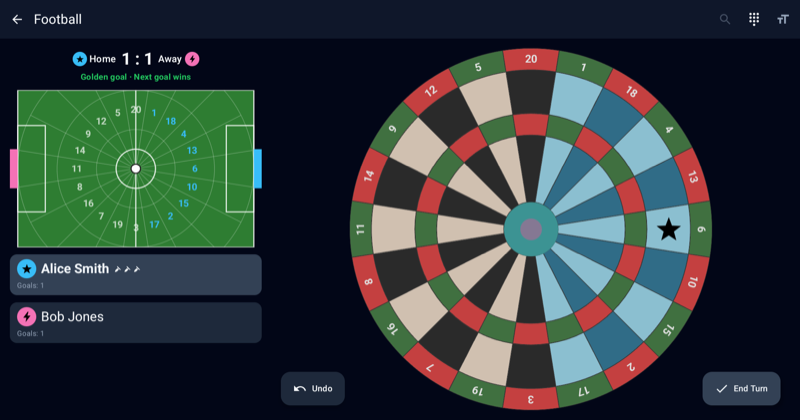
Football turns the dartboard into a boot. Players form two sides, Home and Away, and throw alternately. A ball sits on the centre spot of a pitch, and every dart kicks it: the segment you hit is the direction of the kick, and the ring decides how far the ball rolls. Roll the ball over the opponent's goal line, inside the goal, to score.
Segment values do not matter — a 1 kicks the ball as far as a 20. What matters is the direction. When the round limit is reached, the side with more goals wins the leg, and a tie is settled by golden goal.
Game Setup
| Setting | Value |
|---|---|
| Players | 2, 4, 6, or 8 — an even number, split into two equal sides |
| Sides | Home or Away for each player, alternating by default |
| Round Limit | 5, 10, or 15 rounds (default 15) |
| Format | Single leg or best of N legs |
| Darts per Turn | 3 (1 on the opening kick-off) |
The Pitch
The pitch is 6 steps long and 4 steps wide. The ball starts on the centre spot, 3 steps from each goal line, and the goal is 1 step wide. Home attacks the goal on the 6 side of the board, Away the goal on the 11 side. Every leg starts with the ball on the centre spot, and the ball returns there after every goal.
Kicking the Ball
Every dart kicks the ball from where it lies:
- Direction: the segment you hit is the direction of the kick — 6 to the right, 11 to the left, 20 up, 3 down. Every other segment kicks the ball diagonally, the way it points on the board.
- Distance: a single kicks the ball 1 step, a double 2 steps, and a triple 3 steps.
- Bull: the outer bull shoots the ball 1 step straight at the goal you attack, the bullseye 2 steps.
- Miss: the ball does not move.
Goals
When the ball crosses a goal line inside the goal, the side attacking that goal scores — even if a player of the other side kicked it. That is an own goal, and it counts. After a goal the turn ends at once: the remaining darts are not thrown, and the ball goes back to the centre spot.
A ball resting on the goal line is not a goal yet, even inside the goal. The next kick that carries it over the line inside the goal scores.
Out of Play
If the ball leaves the pitch anywhere else, it stops on the line where it went out. A ball on a line that is kicked further outward does not move. Between turns the ball stays where it lies.
Kick-Off
The first turn of every leg is the kick-off: only 1 dart. Every other turn has 3. The short kick-off keeps the game fair — with a full first turn, the side that kicks off could push the ball deep into the opponent's half before the other side throws a dart.
Winning
- Round limit: a round is one turn of every player. When every player has thrown the round limit of turns, the side with more goals wins the leg.
- Golden goal: on a tie the leg goes on from where the ball lies, and the next goal wins it at once — own goals included.
- Legs: every player of the winning side gets the leg. The next leg starts at 0 : 0 from the centre spot, and the side that kicks off alternates. The first side to win the required number of legs wins the match.
Game Flow Example
A one-on-one leg, Home against Away:
| Turn | Side | Darts | Result | Score (Home : Away) |
|---|---|---|---|---|
| 1 | Home | Single 6 | Kick-off, 1 dart only: the ball rolls 1 step toward the Away goal | 0 : 0 |
| 2 | Away | Triple 11, Single 11, Miss | The ball rolls 4 steps left and stops on the Home goal line — not a goal yet | 0 : 0 |
| 3 | Home | Triple 6, Triple 6, Single 13 | Cleared to the centre spot, kicked onto the Away goal line, then pushed over it inside the goal — goal for Home, and the ball goes back to the centre spot | 1 : 0 |
| 4 | Away | Triple 20, Single 20, Single 3 | The triple would carry the ball off the pitch, so it stops on the sideline. Single 20 kicks it further out and it does not move; Single 3 brings it 1 step back | 1 : 0 |
Confirmation Mode
Confirmation Mode is an optional setting you can turn on when creating a game, or toggle mid-game from the top bar. Tapping the dartboard opens a magnified 1.5× overlay showing the segment you hit, its two neighbors, and the Bull — tap the correct segment to confirm the score, or tap outside the overlay to cancel with nothing scored. It's especially useful in front of a goal, where one wrong segment sends the ball the wrong way. Misses are always registered immediately and skip the confirmation step.
Strategy Tips
- Aim from the ball to the goal: aim at the segment that points from the ball to the goal. Near a sideline, aim diagonally — 13 or 10 instead of 6 for Home.
- Clear the ball first: when the ball is near your own goal, kick it away before you think about attacking.
- Mind your own goal: stay away from the segments facing your own goal. A stray dart there can be an own goal.
- Use the bull when the ball is level with the goal: the outer bull and the bullseye shoot straight along the pitch, never diagonally. From the side of the pitch they only reach the goal line next to the goal.
Related Games
Related Articles
Play Football Now
Split into Home and Away, pick a round limit of 5, 10, or 15, and kick off. No download needed for the web version.
Play Now